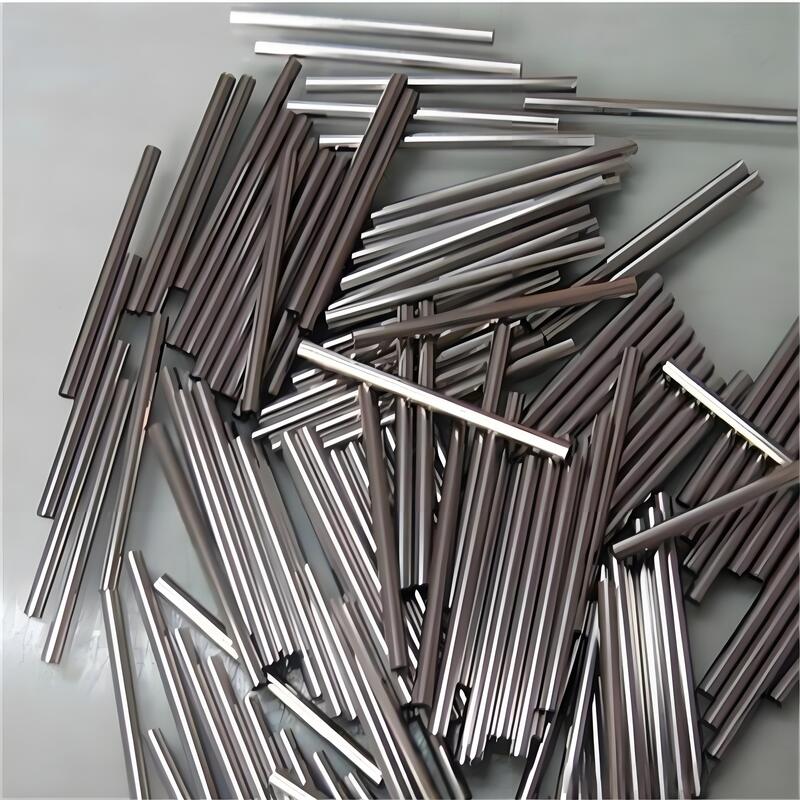
プロダクト細部
起源の場所: 中国、上海
ブランド名: TANKII
証明: ISO9001, SGS
モデル番号: インバー36
支払及び船積みの言葉
最小注文数量: 10kg
価格: 交渉可能
パッケージの詳細: 木製ケース
受渡し時間: 7~20日
支払条件: L/C、T/T、ウェスタンユニオン
供給の能力: 月産100トン
型番: |
アンバー |
外径: |
0.2mm min。 |
WT: |
0.015mm |
長さ: |
0.2mm min。 |
形: |
コイルパイプ。キャピラリパイプ;シームレスパイプ |
表面: |
明るい |
サンプル: |
少量の注文も受け付けます |
型番: |
アンバー |
外径: |
0.2mm min。 |
WT: |
0.015mm |
長さ: |
0.2mm min。 |
形: |
コイルパイプ。キャピラリパイプ;シームレスパイプ |
表面: |
明るい |
サンプル: |
少量の注文も受け付けます |
4J36 (Invar) is used where high dimensional stability is required, such as precision instruments, clocks, seismic creep gauges, television shadow-mask frames, valves in motors, and antimagnetic watches. In land surveying, when first-order (high-precision) elevation leveling is to be performed, the Level staff (leveling rod) used is made of Invar, instead of wood, fiberglass, or other metals. Invar struts were used in some pistons to limit their thermal expansion inside their cylinders.
4J36 use oxyacetylene welding, electric arc welding, welding and other welding methods. Since the coefficient of expansion and chemical composition of the alloy is related should be avoided due to welding causes a change in the alloy composition, it is preferable to use Argon arc welding welding filler metals preferably contains 0.5% to 1.5% titanium, in order to reduce weld porosity and crack.
Normal composition%
| Ni | 35~37.0 | Fe | Bal. | Co | - | Si | ≤0.3 |
| Mo | - | Cu | - | Cr | - | Mn | 0.2~0.6 |
| C | ≤0.05 | P | ≤0.02 | S | ≤0.02 |
Coefficient of expansion
| θ/ºC | α1/10-6ºC-1 | θ/ºC | α1/10-6ºC-1 |
| 20~-60 | 1.8 | 20~250 | 3.6 |
| 20~-40 | 1.8 | 20~300 | 5.2 |
| 20~-20 | 1.6 | 20~350 | 6.5 |
| 20~-0 | 1.6 | 20~400 | 7.8 |
| 20~50 | 1.1 | 20~450 | 8.9 |
| 20~100 | 1.4 | 20~500 | 9.7 |
| 20~150 | 1.9 | 20~550 | 10.4 |
| 20~200 | 2.5 | 20~600 | 11.0 |
Typical Physical properties
| Density (g/cm3) | 8.1 |
| Electrical resistivity at 20ºC(OMmm2/m) | 0.78 |
| Temperature factor of resistivity(20ºC~200ºC)X10-6/ºC | 3.7~3.9 |
| Thermal conductivity, λ/ W/(m*ºC) | 11 |
| Curie point Tc/ ºC | 230 |
| Elastic Modulus, E/ Gpa | 144 |
Kovar is a nominal 29%Ni-17%Co-54%Fe alloy that is a well-known glass-sealing alloy suitable for sealing to hard glasses. Kovar has a nominal expansion coefficient of approximately 5 ppm/°C and inflection temperature of ~450 °C (840 °F).
Kovar (ASTM F15) has been used for making hermetic seals with the harder Pyrex glasses and ceramic materials. This alloy has found wide application in power tubes, microwave tubes, transistors, and diodes. In integrated circuits, it has been used for the flat pack and the dual-in-line package.
Chemical Composition
| Grade | C% | P% | S% | Mn% | Si% | Cu% | Cr% | Mo% | Ni% | Co% | Fe% |
| Kovar | Max 0.03 | Max 0.020 | Max 0.020 | Max 0.50 | Max 0.30 | Max 0.20 | Max 0.20 | Max 0.20 | 41.5-42.5 | 0.1 | Bal. |
Specifications
| Grade | UNS | Werkstoff Nr. | ASTM | |
| Kovar | K94610 | 1.3981 | F15 | |
Physical Properties
| Grade | Density | Melting Point |
| Kovar | 8.17 g/cm3 | 1449°C |
Mechanical Properties
| Grade | Tensile Strength N/mm² | ||||
| Soft | 1/4 Hard | 1/2 Hard | 3/4 Hard | Full Hard | |
| Kovar Strip | <570 | 520-630 | 590-700 | 600-770 | >700 |
| Kovar Wire | <585 | 585-725 | 655-795 | 725-860 | >860 |
Coefficient of Expansion
| Alloy | Linear Coefficient of Thermal Expansion ā,10-6/ºC | |||||||
| 20-200ºC | 20-300ºC | 20-400ºC | 20-450ºC | 20-500ºC | 20-600ºC | 20-700ºC | 20-800ºC | |
| Kovar | 5.9 | 5.3 | 5.1 | 5.3 | 6.2 | 7.8 | 9.2 | 10.2 |
![]()